In the spirit of respect, reciprocity and truth, I honor and acknowledge the land beneath our feet, stewarded by many generations of Indigenous peoples.
My professional life at the University of Calgary is only made possible by the abundance of knowledge and teachings provided by the land and water of this place, now known as “Calgary.” Before coloniazation, this land was called Moh-kíns-tsis (Blackfoot), Wincheesh-pah (Nakoda), Otos-kwunee (Cree), Kootsisáw (Tsuu’tina) and Klincho-tinay-indihay (Slavey). Long before it was colonized, this land beneath our feet were stewarded by the Niitsitapi (Blackfoot Confederacy), the Îethka Nakoda, and the Tsuut’ina Nations, and more recently by the Otipemisiwak Métis. I am aware of our privilege to live, grow, play, and learn on this land and commit to enact my responsibility to give back to the land.
Through our Soil Camp project, our collective work toward food justice, we grow many varieties of vegetation and plants that have sustained our culturally relevant diets while honouring and respecting plants of Indigenous people that sustained and nourished the people of this land for generations; Aóhtoksóoki (yarrow), Puck-keep (chockecherry), Aphahsipoko (dogwood), Sipatsimo (sweet grass) to name a few among many others.
As an educator and educational researcher, I acknowledge the past wrongdoings done through schooling on Indigenous communities and commit to reflect on Canada’s colonial histories and learn to act toward the resurgence of Indigenous communities.
As an immigrant settler to this land now called “Calgary,” I continue to learn to unsettle my settler identity, by humbly listening to generational wisdoms and knowings passed down in Indigenous communities on this land. In this process, I also connect with intergenerational wisdoms that my ancestors passed down to me, through their deep connection and relationships with their ancestral lands.
While symbolic gestures are important in affirming our commitment to facing the history of settler colonialism, we must move beyond mere symbolism and take reciprocating actions.
A list of collective actions I greatly appreciate and support, for example, https://landback.org, https://legacyofhope.ca, https://www.relationalsciencecircle.com/ancestralscience, and https://indspire.ca/.
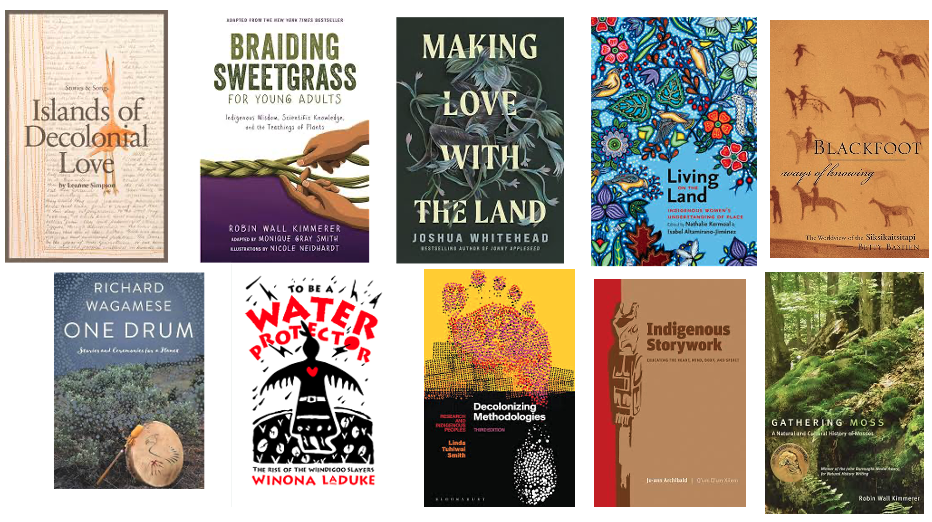
I appreciate and learn from works written by Indigenous authors (some of my favorite readings are listed here and also on our Soil Camp website and included as a screenshot of book covers – I always appreciate book recommendation!).
Thank you Dr. Kori Czuy for generously sharing your wisdom for me to formulate, revisit, and rewrite this Land Acknowledgement – and one of the central teaching was that the Land Acknowledgement should be personal. This is a living document instead of a static one. I appreciate this ongoing process of learning and grounding.
Sources I have learned from to formulate this land acknowledgement: https://www.ucalgary.ca/indigenous/cultural-teachings/territorial-land-acknowledgement https://www.sparkscience.ca/about/the-land?srsltid=AfmBOorog2aHZc0RRCbnM3op1pOdkPTOVMQyoLVyS0QSWOdk0QezM7Z5 https://calgaryfoundation.org/about-us/reconciliation/land-acknowledgement/ https://www.calgarylibrary.ca/connect/indigenous-services/land-acknowledgment/

 Miwa Aoki Takeuchi, PhD